With children under seven, a nativity play works when the narrator carries the story and the children carry the moments. If Joseph forgets his line, the narrator says it and moves on.
The script below is our own, written from the Gospel accounts; print it and change it as you like. After it: casting, a rehearsal plan, costumes, and what comes from the Bible versus tradition. Children always ask about the donkey.
Three rules for three-year-olds
- The narrator speaks about 80% of the text. When a child freezes, the narrator says the line and the play goes on.
- One child, one line, tied to a movement: knocking, pointing, laying down a gift. A four-year-old remembers a sentence that goes with a gesture.
- Everyone stays on stage, sitting in a semicircle and standing only for their scene. No backstage, no lost sheep.
The script (5 scenes, about 15 minutes)
We give only carol titles. All four are public domain in their classic form: ‘Away in a Manger’ (printed 1885, Hymnary), ‘O Come, All Ye Faithful’ (Oakeley’s 1841 translation, Hymnary), ‘Silent Night’ (Mohr 1818, English by J. F. Young 1863, Hymnary) and ‘We Three Kings’ (Hopkins 1857, Hymnary). history Modern arrangements may not be.
Scene 1. The road to Bethlehem (about 2 minutes)
Mary and Joseph walk along the semicircle. Innkeepers stand by chairs as “doors”.
Narrator: Long ago the emperor ordered everyone to be counted in their family’s home town. So Mary and Joseph set off for Bethlehem. Mary was expecting a baby very soon.
Joseph (knocks): Hello! Do you have a room for the night?
Innkeeper 1: No room! We’re full!
Innkeeper 2: Full here too. Try next door.
Innkeeper 3: I only have a stable. But it’s warm and dry.
Mary: Thank you. That is enough for us.
Scene 2. The stable (about 3 minutes with the carol)
Mary and Joseph sit by the manger. The sheep crawl in and lie down around it.
Narrator: That night, in the little stable, Mary’s baby was born. She wrapped him up and laid him in the manger, because there was no room for them in the inn. They called him Jesus.
Carol: ‘Silent Night’. Everyone sings; the sheep sway gently from side to side.
Scene 3. The angel and the shepherds (about 3 minutes with the carol)
Shepherds sit by a “campfire” of red tissue paper.
Narrator: Out in the fields nearby, shepherds were looking after their sheep through the night.
Shepherd 1: Brr, it’s cold tonight.
Shepherd 2 (points up): Look! What a bright light!
Angel: Don’t be afraid! I bring you happy news. A Saviour is born! You will find the baby lying in a manger.
Little angels (all together): Glory to God in the highest!
Shepherd 3: Let’s go to Bethlehem!
Shepherd 4: Let’s take the baby a lamb!
Carol: ‘Away in a Manger’. The shepherds lay a toy lamb and a basket by the manger.
Scene 4. The star and the wise men (about 3 minutes with the carol)
A child holding a star on a stick leads three wise men around the stage.
Narrator: Far away in the east, wise men saw a new star. They followed it until it stopped over the place where the child was.
Star: Follow me!
Wise man 1 (kneels): I bring gold.
Wise man 2: I bring frankincense.
Wise man 3: And I bring myrrh.
Narrator: Gold for a king, incense for God, myrrh for a man. That is how Christians have long explained the gifts.
Carol: ‘We Three Kings’ (for the youngest, just the first verse and the chorus).
Scene 5. Everyone at the manger (about 3 minutes with the carol)
All the children stand up and take one step forward.
Narrator: Jesus came for everyone: poor shepherds and wise travellers from far away. He comes to us too.
All the children: Happy Christmas!
Carol: ‘O Come, All Ye Faithful’, with the audience. Print the first verse on the invitation so parents can join in.
Casting: 8 to 25 children
| Part | Children | Good for |
|---|---|---|
| Narrator | 1 adult | teacher, catechist |
| Mary, Joseph | 2 | a calm child; a child who likes to do something |
| Innkeepers | 1–3 | loud voices |
| Sheep | 2–8 | the youngest and shyest (no lines) |
| Angel | 1 | your most confident speaker |
| Little angels | 2–6 | want a part, not a solo |
| Shepherds | 2–4 | anyone |
| Star | 1 | the child who can’t stand still |
| Wise men | 3 | children who love dressing up |
The smallest cast is 8 (Mary, Joseph, Angel, two shepherds, three wise men); for 25, add sheep, angels and innkeepers. Put a shy child with the sheep or the little angels, never in a forced solo.
With 3–4-year-olds, the narrator says every line and the children only act: 8 to 10 minutes. With 6–8-year-olds, add a short Herod scene after Scene 4, ending: “The wise men were warned in a dream and went home by another road” (Mt 2:12).
Rehearsal plan: three weeks, four sessions of 20 minutes
For a play in the last week before the Christmas break, start at the beginning of Advent: Sunday 29 November (Catholic Culture).
- Week 1: carols only, one a day. If the children know the carols, the rest falls into place.
- Week 2: parts and movement. Entrances and gestures only; the narrator still says the lines.
- Week 3: two run-throughs and a dress rehearsal. Crowns slip and wings catch on chairs; better at rehearsal than on the day.
- Agree with parents whether videos of the children may go online.
Costumes and props from things at home
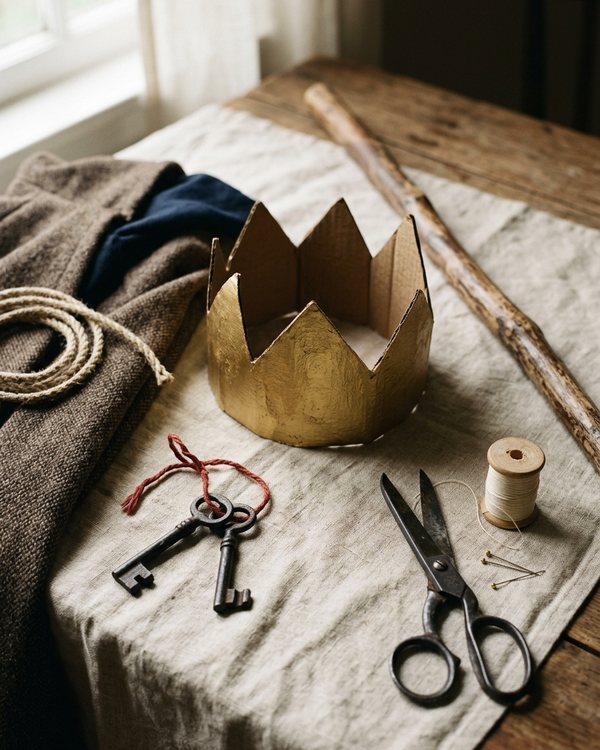
A tunic is a bedsheet folded in half with a head hole, tied with a rope. Crowns and wings are cardboard. The no-sew method is in All Saints’ Day costumes for kids.
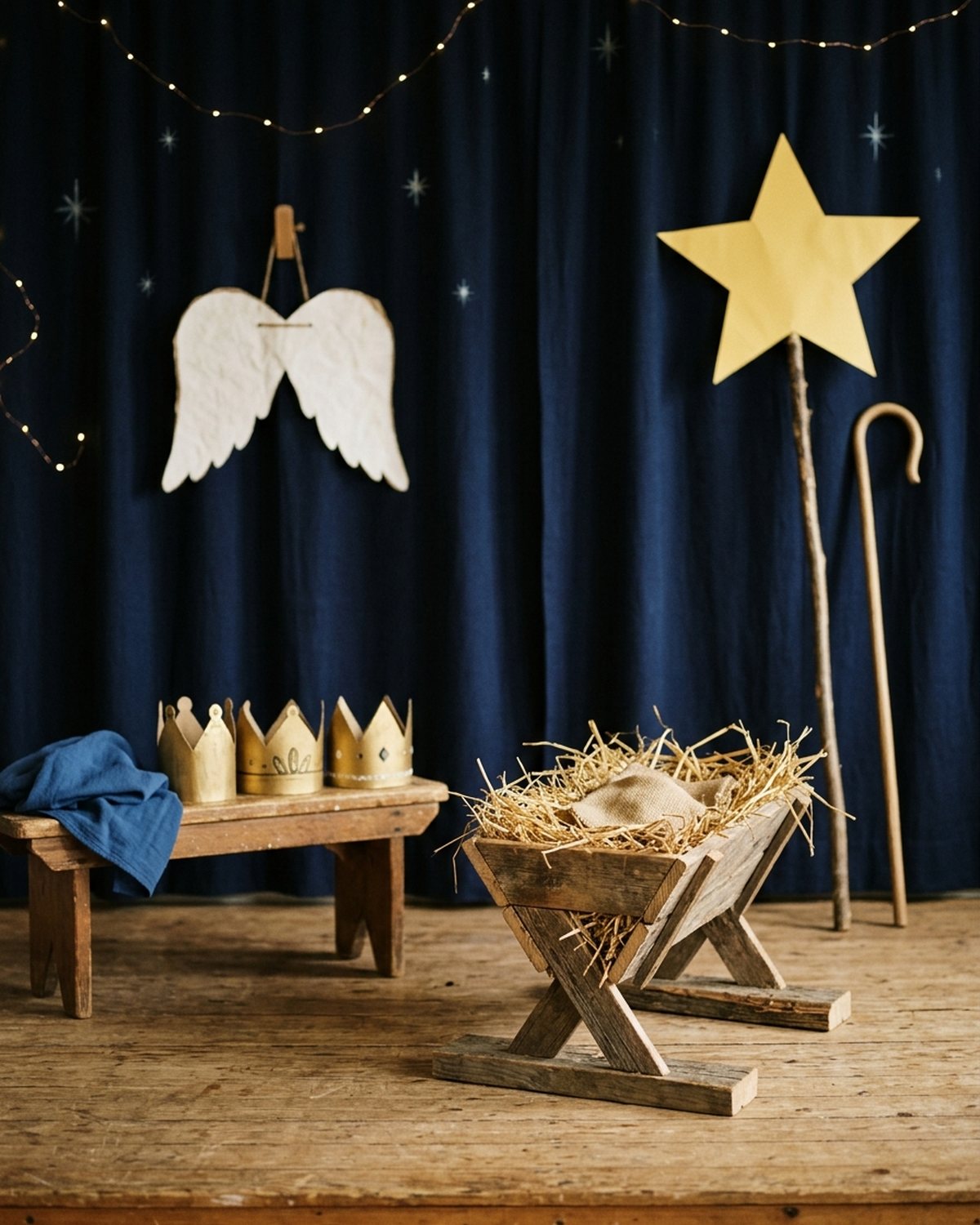
- Manger: a fruit crate with hay or shredded paper, and a doll in a white cloth
- Star on a garden cane
- Three gifts: a gold box, a jar, a jug
- A toy lamb and a dark blanket for the backdrop
What comes from the Gospel and what from tradition
| Element of the play | Where it comes from |
|---|---|
| The census and the journey to Bethlehem | Scripture Luke 2:1–5 |
| The manger, “no room for them in the inn” | Scripture Luke 2:7 |
| Innkeepers who say no, and one who offers a stable | tradition: Luke says only that there was no room |
| The ox and the donkey | tradition: not in the Gospels; linked from early on to Isaiah 1:3, “An ox knows its owner, and an ass, its master’s manger” |
| The angel, the shepherds, “Glory to God in the highest” | Scripture Luke 2:8–14 |
| The star, the magi from the east, gold, frankincense and myrrh | Scripture Matthew 2:1–11 |
| That there were three, and that they were kings | tradition: Matthew gives no number and calls them magi |
| The names Gaspar, Melchior and Balthasar | tradition, in the West from about the 7th century |
| Shepherds and wise men at the manger on the same night | tradition: Matthew says the magi entered “the house” (Mt 2:11), so it was later |
| Herod | Scripture Matthew 2:1–16 |
The Catholic Encyclopedia notes that no Father of the Church held the magi to be kings; the royal image came from Psalm 72 in the liturgy (Catholic Encyclopedia: Magi). history It calls the ox and the ass “a very ancient tradition” tied to Isaiah (Catholic Encyclopedia: Crib). tradition Tradition is not a mistake; it just helps to know which is which.
Where nativity plays come from
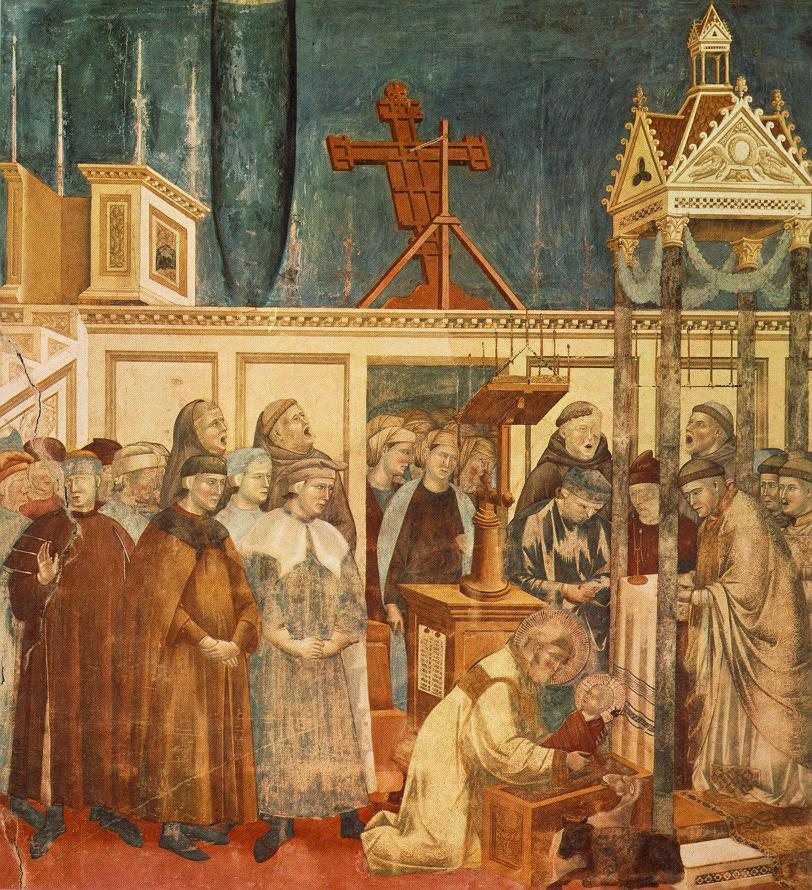
Greccio, Christmas 1223. Fifteen days before Christmas, St. Francis of Assisi asked a local man named John to prepare a manger full of hay, with an ox and a donkey. On Christmas night the friars and townspeople gathered there for Mass, as his first biographer, Thomas of Celano, recorded. In Admirabile signum (2019) Pope Francis stressed one detail: at Greccio there were no statues; the scene was made by the living people who came (vatican.va). history Devotion to the crib is older, but Francis made it popular and gave it the shape we still know (Catholic Encyclopedia). history
After the play, ask: “Who came to see baby Jesus first?” The shepherds: ordinary people from the fields, not kings. It is the shortest catechesis there is.
Eryk from holyholyholy.pl
Eryk makes HOLY! HOLY! HOLY! in Poland together with Sylwia and their children. He writes the rules, digs through the sources and works on the pictures; the children play first and criticise hardest (Joseph of Egypt is in the deck because their son asked for him). Every one of the 571 questions in the game was checked against its source. Here he writes about talking with children about the saints: concretely, with sources, without sugar-coating.
Frequently asked questions
How long should a preschool nativity play be?
For three- to six-year-olds, 10 to 15 minutes. Longer than that and the little ones start wandering off the stage, and the audience with toddlers on their laps gets restless too. Five short scenes and four carols of two verses each fit comfortably.
Can I use these carols without paying for a licence?
The traditional texts and tunes of ‘Away in a Manger’, ‘O Come, All Ye Faithful’, ‘Silent Night’ (John Freeman Young’s translation) and ‘We Three Kings’ are in the public domain. Modern arrangements, new verses and backing tracks may still be under copyright, so check the version you print or play.
Do we need Herod in the play?
No. Herod is in Matthew’s Gospel, but for preschoolers the scene is too dark and can be left out. With children aged 6 to 8 you can add a short scene where Herod questions the wise men and they go home another way.
How many wise men were there, and were they kings?
The Gospel gives neither their number nor their names and does not call them kings; it calls them magi from the east. The number three most likely comes from the three gifts, and the names Gaspar, Melchior and Balthasar appear in the West from about the seventh century. It is a lovely tradition, but not the text of Scripture.
Were the ox and the donkey really in the stable?
The Gospels do not mention them. Christians added them early on because of Isaiah 1:3, which says the ox knows its owner and the donkey its master’s manger, and St. Francis put a real ox and donkey at the first living crib in Greccio.
Sources
Marks: [H] — Scripture, document, recorded fact · [T] — tradition, legend, custom · [N] — Church teaching · [D] — study, data.
- HLuke 2 — New American Bible, Revised Edition (bible.usccb.org)
- HMatthew 2 — New American Bible, Revised Edition (bible.usccb.org)
- TIsaiah 1 — New American Bible, Revised Edition (bible.usccb.org)
- HPope Francis, Apostolic Letter Admirabile signum on the meaning and importance of the Nativity scene (1 December 2019), no. 2 (vatican.va)
- TCatholic Encyclopedia: Crib (newadvent.org)
- TCatholic Encyclopedia: Magi (newadvent.org)
- DHymnary.org: Away in a Manger (text, 1885; public domain)
- DHymnary.org: O Come, All Ye Faithful (J. F. Wade, tr. F. Oakeley 1841; public domain)
- DHymnary.org: Silent Night, Holy Night (J. Mohr 1818, tr. J. F. Young 1863; public domain)
- DHymnary.org: We Three Kings of Orient Are (J. H. Hopkins Jr., 1857; public domain)
- DCatholic Culture: First Sunday of Advent, 29 November 2026